Crafting Personal Connections with Procreate Greeting Card Templates
In a digital world saturated with generic "Happy Birthday" posts and automated e-cards, the tactile experience of a physical greeting card holds significant weight. For artists, illustrators, and entrepreneurs, however, creating a card from scratch can be a logistical headache. You have the talent to draw the design, but setting up the bleed, the fold lines, and the print specifications often kills the creative momentum. This is where the utility of a specialized Procreate Greeting Card Templates set becomes an indispensable part of your design assets. It bridges the gap between a spontaneous sketch and a professional, tangible product.
Beyond the Blank Canvas: Technical Precision Meets Creativity
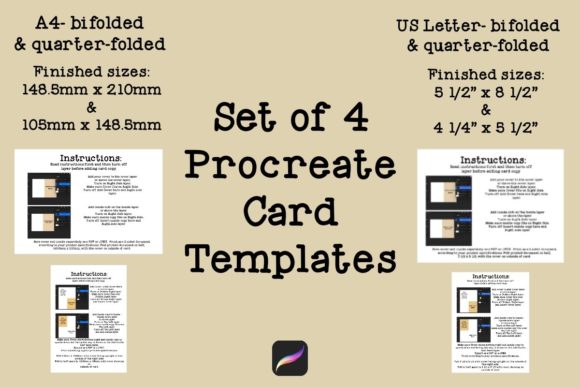
The core value of this particular set lies in its adaptability to global printing standards. The collection includes four distinct templates, acknowledging that your audience might be on the other side of the world or right next door. Two templates are configured for the standard US Letter size of 8.5” x 11”, while the other two cater to the A4 standard of 210mm x 297mm. This distinction is vital for commercial font and design work; using the wrong paper size can lead to awkward cropping or uneven margins that immediately cheapen the final product.
However, the true sophistication of this kit is found in the layout logic. Within each paper size, you receive two variations. The first is a single-page template, perfect for a quick front-only design—think minimalist typography or a bold illustration with a simple greeting. The second variation is a front-and-back template. This is where many hobbyists and small business owners stumble. Knowing exactly where to place the back cover text or a secondary illustration without it interfering with the front requires precise alignment. These templates handle the guesswork, ensuring that when you fold the paper, the orientation is perfect.
The Anatomy of a Professional Card
Visually, when you open these files in Procreate, you will notice a clean, unobtrusive interface. They typically feature subtle guides for the "safe zone"—the area where you should keep your most important text or logo design elements to ensure they aren't cut off—and the bleed area, where your design should extend to avoid white edges. This structure encourages a disciplined approach to visual hierarchy. You are forced to consider the focal point: Is the greeting the star, or is it the artwork?
For those working in brand identity, these templates offer a sandbox for consistency. A marketing agency or a freelance illustrator can use these files to create a library of cards that all share the same paper size and fold style, creating a cohesive collection. The personality of the output is entirely up to you, but the framework ensures that the final physical object feels professional. Whether you are aiming for a rustic, hand-lettered aesthetic or a sharp, vector-based modern look, the template serves as the silent foundation.
Practical Applications for Designers and Entrepreneurs
The versatility of this set extends far beyond holiday greetings. For the small business owner, these templates are a pathway to low-cost, high-impact marketing. Instead of ordering expensive bulk prints from a print shop, you can print a limited run of "Thank You" cards in-house. By utilizing the US Letter or A4 templates, you can print directly onto high-quality cardstock using your home or office printer. This is particularly useful for packaging design inserts. A handmade soap seller, for instance, can design a card that includes usage instructions on the back and a beautiful botanical illustration on the front, printed using the two-sided template.
For the digital creator or blogger, these assets can be repurposed for social media graphics. While the templates are designed for print, the layout ratios can be cropped for Instagram posts or Pinterest pins. You can mock up a greeting card design to sell as a digital download on Etsy, using the template to create a realistic preview image. The instructions included with the set are a crucial component here; they demystify the printing process, offering guidance on printer settings and paper handling. This is practical, real-world value that saves time and reduces waste.
Integrating Typography and Design Theory
When working within these templates, your choice of typeface becomes the voice of the card. This is where understanding modern typography pays off. A script font or handwritten font might evoke warmth and personal touch, ideal for wedding invitations or anniversary cards. However, readability is paramount. If your chosen display font is too ornate, the message gets lost.
The templates encourage you to evaluate font pairing. A common strategy for editorial design and card making is to pair a decorative header with a clean, sans serif font for the body text. For example, a bold, artistic serif font for "Happy Holidays" paired with a simple sans serif for the smaller greeting text ensures the card is both striking and legible. The Procreate Greeting Card Templates provide the canvas, but the interplay of fonts and imagery creates the emotional resonance.
Maximizing the Asset Set
To get the most out of this purchase, treat it as a starting point rather than a rigid constraint. Here is a practical workflow for utilizing the templates:
- Select the Size: Determine if you are printing at home (likely A4 or Letter) or sending to a professional printer.
- Choose the Layout: Decide if your design requires a back cover (for logos, contact info, or continued art) or if a single face suffices.
- Design with Intent: Use the guide layers in Procreate to keep critical elements safe. Create your artwork, ensuring it extends to the bleed lines if you want edge-to-edge color.
- Test Print: Before committing to expensive cardstock, do a "draft" print on standard paper. Fold it to check the alignment of the front and back. This step is non-negotiable for the two-sided templates.
Ultimately, the goal of using Procreate Greeting Card Templates is to elevate your work from a digital file to a physical artifact. It removes the technical barriers of print preparation, allowing you to focus on what you do best: creating. Whether you are a designer looking to expand your service offerings, a crafter selling at local markets, or simply someone who values the art of a handwritten note, having a reliable set of templates streamlines the production process and guarantees a polished result.