Notebook Templates for KDP: Launching Your Low Content Publishing Business
The world of Amazon KDP offers a genuine opportunity for entrepreneurs, designers, and content creators to build a passive income stream through low content books. However, the initial hurdle—designing professional, interior layouts from scratch—can be time-consuming and costly. This is where a strategic shortcut becomes invaluable. A bundle of pre-made, high-quality Notebook Templates for KDP eliminates the guesswork, allowing you to focus on marketing and scaling your business rather than wrestling with page layouts and file specifications.
Understanding the Evergreen Appeal of Notebooks
Notebooks and journals represent one of the most consistently selling categories on the platform. They are not a fleeting trend; they are a fundamental tool for students, professionals, artists, and hobbyists. The demand spans from simple college-ruled pads for everyday writing to specialized dot grid books for bullet journaling and hexagon paper for intricate design work. By offering a variety of interior styles, you position your publishing brand to capture multiple segments of this stable market. The key is providing a product that feels intentional and professionally executed, which directly influences buyer perception and the likelihood of positive reviews.
A Curated Collection for Maximum Versatility
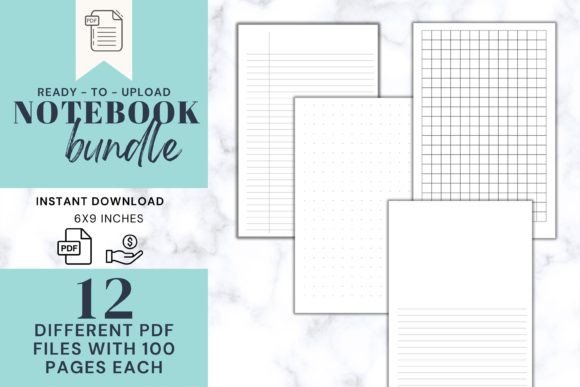
The provided bundle is not a random assortment. It is a thoughtfully curated set of 12 distinct designs, each formatted as a 6x9 inch PDF with no bleed, ready for immediate upload. This size is a popular, portable choice that works well for personal use, academic settings, and creative projects. Each template contains 100 pages, a substantial count that offers good value to the end consumer while remaining a standard, manageable length for KDP production.
The variety within the set is its greatest strength, allowing you to launch multiple titles under one brand or test different niches. The included styles cover a wide spectrum of functionality:
- College Ruled & Wide Ruled: The staples for students and general note-taking, appealing to the broadest audience.
- Graph Paper & Dot Graph: Essential for engineers, designers, architects, and the booming bullet journal community. Dot graph, in particular, is highly sought after for its flexibility in both structured layouts and freeform sketching.
- Half College, Half Graph, Half Wide, Half Wide/Graph: These hybrid layouts are practical genius. They cater to users who need to combine written notes with diagrams, sketches, or mathematical equations on a single page, solving a real-world problem for STEM students and visual thinkers.
- Sketch Book & Journal: Blank or lightly guided pages for artists, writers, and those practicing mindfulness or gratitude journaling. These appeal to a more creative and personal-use demographic.
- Handwriting Practice: Specifically designed for children or adults improving their penmanship, tapping into the educational and self-improvement market.
- Hexagon Paper: A niche but valuable resource for game designers, chemists, and creators of certain types of fantasy maps or intricate artwork.
From Template to Tangible Brand Asset
Viewing these templates merely as printable pages is a missed opportunity. They are the foundational design asset for your publishing imprint. Consistency in interior layout across a series of notebooks builds brand recognition. A customer who appreciates the clean spacing of your college-ruled notebook will likely trust and purchase your dot grid version because the underlying design language—the margins, line weight, and overall feel—is familiar and professional. This is the core of building a brand identity in the low content space; it’s not just about the cover, but the entire user experience.
When selecting a template to upload, consider your target audience’s primary use case. For a notebook aimed at architects, the graph paper template must have precise, clean lines. For a journal marketed to writers, the spacing and paper color (which you can adjust in your publishing software) should minimize eye strain during long writing sessions. Always order a proof copy. This step is non-negotiable. It allows you to assess the actual print quality, check that the lines are dark enough without being harsh, and ensure the binding lies flat for ease of use—factors that heavily influence customer satisfaction and reviews.
Strategic Implementation for KDP Success
Having the templates solves the production problem, but success requires strategic publishing. Start by analyzing Amazon’s search trends and best-seller ranks in the notebooks category. Use relevant keywords naturally in your title and subtitle—phrases like “100-Page Dot Grid Journal for Bullet Journaling” or “6x9 College Ruled Notebook for Students” are descriptive and SEO-friendly. Your cover design is your first and most critical marketing tool. Invest time or resources in creating a professional, appealing cover that clearly communicates the interior style and appeals to your chosen demographic. A mismatched cover—one that looks childish on a professional graph notebook—will deter buyers.
Think about bundling your offerings. You could create a “Designer’s Pack” featuring your sketch, dot grid, and hexagon templates, or a “Student Essentials” bundle with college, wide, and graph ruled options. This increases the average order value and provides a complete solution for your customers. Furthermore, these templates are not confined to KDP. They can be adapted for sale as printable PDFs on Etsy or your own website, or used to create complementary digital products like digital planners for apps such as GoodNotes, expanding your revenue streams beyond physical books.
Ultimately, leveraging a premium set of Notebook Templates for KDP is about efficiency and quality. It removes the technical barriers of design and file formatting, allowing you to operate like a seasoned publisher. You save significant time and money, bypass the need to hire a designer for each new interior, and gain the confidence that your products meet professional standards. This foundation lets you channel your energy into what truly grows a business: understanding your audience, crafting compelling listings, and building a recognizable brand that stands out in the vast Amazon marketplace.